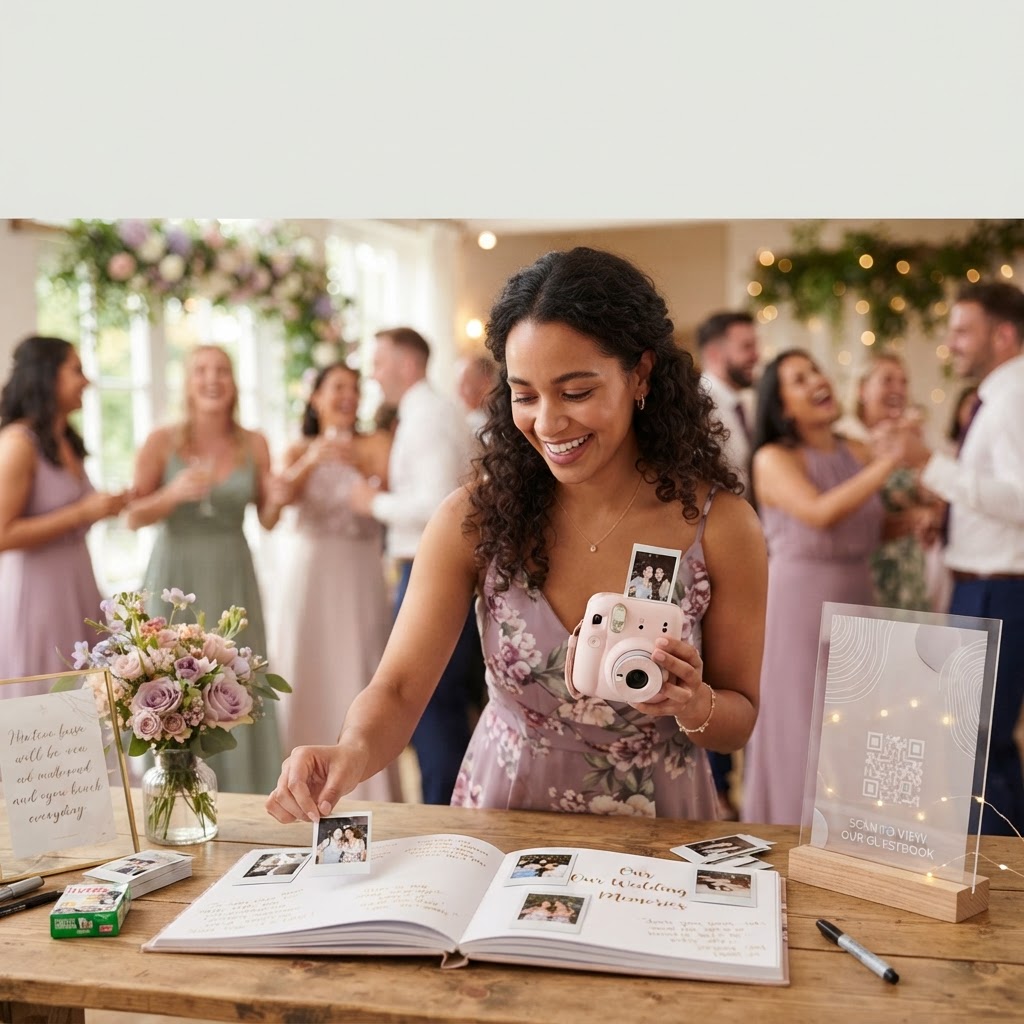
Instant Camera for Wedding Guest Book: Print or QR?
An instant camera for wedding guest book setups costs £100-£300 for 100 guests including film; a QR code guest book is a one-time £39 with unlimited uploads.
Key takeaways
- A 100-guest instant camera guest book costs roughly £60-£150 for the camera plus £1-£2 per photo in film, so budget £100-£300 total.
- Plan 1.5 to 2 frames per guest, meaning 150-200 sheets of instant film for 100 guests, since test frames and pocketed shots add waste.
- Dim reception lighting is the biggest quality problem, so place the table near a lamp or window and pick a camera with an adjustable flash.
- A QR code digital guest book costs a one-time fee per event, collects every guest photo and video with no app download, but produces no physical prints.
- Running both works well: the instant camera is the guest book table activity, and the QR code captures the candid photos the camera misses.
For a 100-guest wedding, an instant camera for wedding guest book use costs roughly £60-£150 for the camera plus £1-£2 per photo in film, so expect £100-£300 total, and every print stays physical. A QR-code digital guest book costs a one-time fee, captures far more photos, but prints nothing. This guide helps you pick one or run both.
What makes an instant camera good for a wedding guest book?
Three features matter for guest book use: print size, film cost, and battery life. Everything else on the spec sheet is decoration.
Print size and signing space
Guests write captions next to each photo, so the print needs room for a pen. Instax mini prints (46 x 62mm image area) fit two or three per guest book page with a line of writing underneath. Larger square formats look great but fill a page per shot, doubling your album size.
Film cost and availability
Film is your real per-guest cost, not the camera. Fujifilm Instax twin packs currently run around £15-20 for 20 shots, so budget roughly £1 per photo (Fujifilm Instax film at John Lewis). For 100 guests, plan 100-150 shots.
Battery life across a long day
A full reception means 8+ hours of standby with bursts of use. Models with rechargeable batteries can die mid-evening; pack a spare or choose a camera that takes AAs you can buy at any petrol station.
If the per-shot maths stings, a digital option like Moment49's guest book takes unlimited photos for a one-time £39 per event, with no film to buy.
How much film do you need per 100 wedding guests?
The per-guest cost calculation
Plan on roughly one shot per guest for the guest book itself, plus a buffer. With 100 guests, that means 100-120 prints for the album, plus the shots guests take home. A safe planning figure is 1.5 to 2 frames per guest, so 150-200 sheets of instant film.
Why guests waste shots (and how to limit it)
Guests burn film on dark test frames, double exposures, and photos of the ceiling. Dim reception lighting is the main culprit, so put the camera near a lamp or window. A small printed sign with three tips (face the light, hold steady, one shot each) cuts waste noticeably. Assigning a confident friend as the "camera keeper" also stops random fiddling.
Illustrative total cost at typical film prices
Film is usually sold in packs of 10-20 sheets, and prices vary by brand, so treat these figures as illustrative:
| Guests | Shots planned | Film packs (20 sheets) | Illustrative cost at £1/sheet |
|---|---|---|---|
| 100 | 150 | 8 | £150 |
| 100 | 200 | 10 | £200 |
If that film bill stings, a digital guest book with a QR code costs a one-time fee instead. Moment49 is £39 per event with unlimited guest uploads, so you can run the instant camera for the album and let everyone else scan and upload the rest (https://moment49.com/AdsLanding).
Should you choose a true instant print camera or a hybrid with QR upload?
True instant print: the classic polaroid camera wedding guest book
Guests take a photo, the print slides out, and it goes straight into the guest book with a handwritten note. No phones, no uploads, nothing to chase afterwards. The trade-offs: film costs roughly £1 per shot, prints are small, and if the flash is weak, dim reception photos come out dark. Check the flash range on the manufacturer's spec sheet before buying, such as Fujifilm's instax pages.
Hybrid cameras: print some, save all
Hybrids print on demand but also save every shot to a phone or SD card, so you keep full-size digital copies without paying for film of every photo. You pay more for the camera up front, and guests still need someone to hand it round.
Digital-only: the QR code route
A printed QR code lets every guest scan and upload photos and video messages from their own phones, with no app and no account, shown on a live slideshow. One-time pricing per event keeps it cheap; Moment49 lists it at £39 on https://moment49.com/Pricing. The catch: no physical prints for the guest book table, which is exactly why some couples run both.
Which instant cameras perform best in dim reception lighting?
Why flash-only shots look flat
Reception lighting is the weak point for any instant camera for wedding guest book setups. Most venues run dim, warm bulbs, so the camera fires its small built-in flash for every shot. That flash only reaches a few metres, lights faces evenly, and blows out skin tones, so every page of your guest book fills with the same flat, white-faced portraits against a black background.
Cheap fixes: positioning, lighting, camera choice
Three fixes cost little. First, park the guest book table near a window for daytime signings or under the brightest fixture in the room. Second, add a warm lamp or two fairy-light strands behind the table so the room reads brighter than the flash. Third, pick a camera with a adjustable flash or a low-light mode rather than the cheapest model, and test one shot in the actual venue lighting before the day. If your guests are mostly shooting on phones instead, a digital guest book handles dim rooms better, and you can tune the upload settings in advance at https://moment49.com/Settings.
How do you set up a guest book table so guests actually use the camera?
A camera left loose on a table gets ignored. Put it where guests queue anyway: beside the guest book, under decent light, with a sign that does the explaining for you.
Signage that gets used
One line is enough: "Take a photo, stick it in the book, sign your name." A framed A4 sign beats a handwritten note, and a printed example photo taped beside it shows shy guests exactly what to do.
Pens, adhesive, and album layout
Use a fine-tip permanent pen (gel pens smudge on instant film) and photo corners or washi tape instead of glue, so prints sit flat and don't curl. Leave a blank spread open at the start; guests copy what they see.
Assigning a camera minder
Give the job to a confident bridesmaid or usher: swap film packs, nudge shy tables, and restart the camera if it sleeps. If you'd rather skip film entirely, a QR code guest book like Moment49 collects every guest photo for a one-time £39 per event with a 7-day upload window (Moment49), and you can review what gets shared beforehand via https://moment49.com/Moderation.
How does an instant camera guest book compare to a wedding QR code photo wall?
An instant camera gives you physical prints on the day but loses every photo nobody printed. A QR code guest book collects every candid moment from every guest's camera roll, shows them live on a slideshow, and hands you the full gallery afterwards. Pick based on whether you want a table activity or the photos themselves.
Cost comparison for a 100-guest wedding
Film is the recurring cost with instant cameras: at roughly 10 shots per pack and £1-2 per shot, 100 guests who each take two photos can burn through £200-400 of film, and that scales with how popular the table is. A digital guest book is a one-time payment per event, with no per-photo cost, so 50 photos or 500 cost the same. The instant camera also caps your photo count at however many packs you buy, while a QR code removes that ceiling entirely.
Where the photos end up afterwards
With an instant camera, the print is the only copy unless a guest also photographed it on their phone, which rarely happens. Guests stick prints in a physical guest book, and that album is lovely but lives in a drawer, and any blurry or dim shots are permanent. With a QR code upload, guests scan, upload, and keep shooting, so you receive every photo and video message in one private gallery afterwards, downloadable in full. The trade-off is honest: you get far more photos, but none of them are physical until you print your favourites yourself, and a phone with a dead battery uploads nothing.
Running both together
You don't have to choose. Put the instant camera on the guest book table as the activity, and print the QR code on a table card so every guest can also scan and upload from their own camera roll. The prints give you the guest book to keep; the gallery gives you the hundreds of candid moments you'd otherwise never see.
How do you adapt the same setup for birthday party photos and other events?
Smaller guest counts, smaller film budgets
Scale the film maths down rather than the setup. For a 30th birthday with 40 guests, one or two film packs covers candid moments at the guest book table, versus the six-plus packs a 100-guest wedding needs. Keep the same lighting rule: a table lamp or warm bulb near the camera makes dim-room shots usable.
Reusing a QR setup across events
A QR code upload wall costs nothing extra to repeat for a christening, anniversary, or work party. Couples reviewing Wedibox on The Knot describe guests simply scanning a code and uploading, with no app download or account, and being able to split uploads by part of the day (reviews). For one-off events, a one-time payment per event beats buying film you may not use again.
What is the best instant camera for wedding guest book setups on a budget?
Under £100 all-in
A basic true instant camera plus a few twin packs of film gets you prints in guests' hands, but the trade-off is real: at roughly £1-2 per shot, your film budget runs out fast and dim reception lighting produces washed-out flash photos. Buy the cheapest reliable body you can find and spend the savings on film.
£100-250 all-in
A hybrid camera gives you prints plus digital copies saved to a card, so the candid moments survive even if prints get pocketed. The trade-off is a higher upfront cost and a slightly bulkier camera that guests need a minute to figure out.
Skip the camera, go digital-only
A QR-code digital guest book like Moment49 (£39 one-time per event) collects every guest photo with no film cost and no app download, shown as a live slideshow. The trade-off: nothing physical on the table, so pair it with a printed guest book if you want ink on paper.
FAQ
Do guests need to download an app to upload photos with a wedding QR code?
No. Guests scan the printed QR code with their phone camera and upload photos or video messages directly through the browser, with no app download and no account to create. That removes the main friction point, since older relatives and anyone with a full phone can still contribute in under a minute.
How many photos will we actually get from a polaroid camera wedding guest book?
Plan on 100-150 prints for 100 guests, based on roughly one guest book shot each plus a buffer for test frames and photos guests pocket. Your ceiling is the film you buy, not the guest count, so 10 packs of 20 sheets is a safe maximum for a typical reception.
Can you use a guest book for wedding with photos if half your guests are abroad?
An instant camera can't help here, since it needs hands on the camera. A QR code guest book works from anywhere with a signal: overseas guests scan the same code, upload from their camera roll, and appear in the same gallery and slideshow. Some services also split uploads by part of the day.
Is an instant camera or a QR code guest book cheaper for 150 guests?
The QR code route, by a wide margin. Film at roughly £1-2 per shot means 150 guests taking two photos each can cost £300-400, scaling with popularity. A digital guest book is a one-time payment per event, so 150 uploads or 500 cost the same, with no film ceiling to plan around.
What do you do with instant photos after the wedding?
The prints live in the guest book album, stuck with photo corners or washi tape alongside each guest's caption. Keep the album flat and out of direct sunlight, since instant film fades over years. Any blurry or dark shots are permanent, so curate gently and accept the imperfect ones as part of the record.